In 2026 the job market rewards a combination of deep technical expertise, strategic business thinking, and human-centered skills that machines can’t fully replicate. Whether you’re pivoting careers or doubling down on growth, focusing on the right skills will open higher-pay roles, faster promotion tracks, and more negotiating power. Below are eight of the highest-paying, highest-impact skills to build this year — what they mean, why they pay well, and how to start learning them.
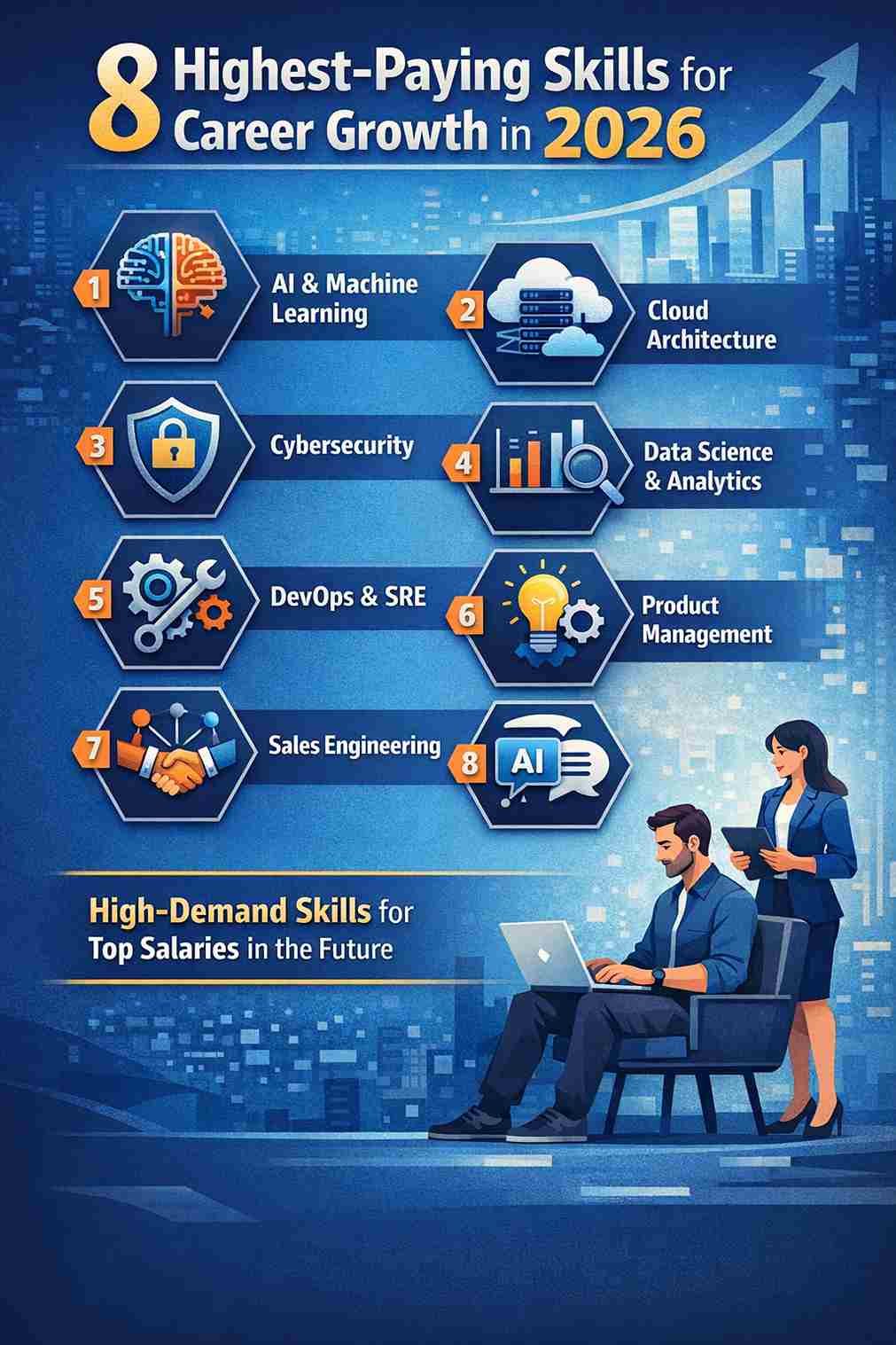
1. Advanced AI & Machine Learning Engineering
Why it pays: Organizations across industries — from fintech to healthcare — are embedding AI to automate decision-making, personalize customer experiences, and unlock insights. Experts who can design, optimize, and productionize large-scale ML systems (including LLMs and multimodal models) command top salaries.
What to learn: deep learning (transformers, diffusion), model fine-tuning, MLOps (pipelines, monitoring), model safety and evaluation, prompt engineering for LLMs.
How to start: hands-on projects (training/fine-tuning models on real datasets), courses from reputable providers, contribute to open-source ML infra, and build a portfolio of deployed models.
2. Cloud Architecture & Cloud-native Engineering
Why it pays: Cloud-first infrastructure is the backbone of modern products. Cloud architects who design resilient, cost-efficient systems and engineers who implement serverless, containerized, and microservices architectures are in high demand.
What to learn: AWS/GCP/Azure services, Kubernetes, Terraform/infra-as-code, serverless patterns, cost optimization, observability and disaster recovery.
How to start: get certified, design and deploy real systems (multi-region apps, CI/CD pipelines), and internalize cloud cost and security trade-offs.
3. Cybersecurity & Cloud Security
Why it pays: As cyber threats scale, companies need specialists to secure data, identity, and infrastructure. Senior security roles (cloud security, red teaming, security architects) carry premium compensation due to high impact and scarcity.
What to learn: threat modeling, identity/access management, SRE-security intersection, incident response, penetration testing, secure software development lifecycle.
How to start: obtain certifications (e.g., CISSP, OSCP for pen testing), run tabletop incident-response drills, and demonstrate security improvements or audits in production systems.
4. Data Science & Advanced Analytics
Why it pays: Businesses that monetize data and make data-driven decisions outperform peers. Senior data scientists and analytics leaders translate messy data into strategic decisions, forecast demand, and build pricing/optimization algorithms.
What to learn: statistical modeling, causal inference, time-series forecasting, feature engineering, scalable data pipelines, and business KPI alignment.
How to start: build end-to-end projects that answer business questions, showcase storytelling via dashboards, and get comfortable with big-data tools (Spark, dbt, data warehouses).
5. DevOps & Site Reliability Engineering (SRE)
Why it pays: Reliability and velocity are competitive advantages. Engineers who automate delivery, scale systems smoothly, and reduce downtime are critical — and well compensated — because they directly impact revenue and reputation.
What to learn: CI/CD, observability (tracing, metrics, logging), chaos engineering, capacity planning, and incident management playbooks.
How to start: own a service’s lifecycle, automate deployments, and produce measurable improvements (faster release time, fewer incidents).
6. Product Management with Technical Fluency
Why it pays: Senior product managers who combine technical fluency with user empathy and business savvy drive product strategy and revenue. In tech companies, product leaders can reach executive pay bands and equity upside.
What to learn: product discovery, experimentation (A/B testing and causal inference), roadmapping, stakeholder management, and basic engineering principles to partner with developers.
How to start: lead cross-functional initiatives, run experiments that move metrics, and learn to craft crisp product strategy docs and metrics-driven roadmaps.
7. Sales Engineering & Solutions Architecture
Why it pays: Complex B2B products require technical sellers — sales engineers and solutions architects — who can map product capabilities to customer needs and close large deals. Compensation often includes commission and high base pay.
What to learn: deep product knowledge, demo engineering, proposal design, negotiation basics, and industry-specific domain knowledge.
How to start: shadow sales calls, build demo configurations, and develop case studies showing how your solution reduced cost or increased revenue for customers.
8. Generative AI Prompting & LLM Productization
Why it pays: Generative AI is no longer a novelty — companies need practitioners who can reliably build useful, safe, and scalable LLM-driven products. Experts who craft robust prompting strategies, retrieval-augmented generation (RAG) systems, and guardrails are extremely valuable.
What to learn: prompt engineering patterns, prompt chaining, RAG and vector databases, evaluation metrics for generative outputs, and ethics/safety practices.
How to start: prototype LLM-based features (chat assistants, summarizers, code helpers), measure improvements in user tasks, and document prompt templates and evaluation processes.
How to pick which skills to pursue
-
Match with industry demand: Tech, healthcare, finance, manufacturing, and legal tech are actively hiring for many of the skills above. Pick a domain where you can leverage domain knowledge.
-
Leverage adjacent strengths: If you’re already an engineer, adding ML, SRE, or cloud skills offers a faster route to higher pay. If you’re in product or sales, deepen technical fluency to access leadership roles.
-
Aim for T-shaped skills: Combine deep expertise in one area with broad complementary skills (e.g., ML + MLOps + product thinking).
Learning strategy for maximum ROI
-
Project-first learning: Build real, end-to-end projects that solve business problems. Employers value demonstrated impact over certificates.
-
Measure impact: Track outcomes — revenue saved, time reduced, model accuracy improvements — and quantify them on your resume.
-
Network and mentor: Join industry communities, open-source projects, and find mentors to accelerate learning and get referrals.
-
Go beyond tutorials: After courses, implement systems in production-like environments and handle edge-cases and failure modes.
-
Keep ethics and communication sharp: High-paying roles need clear communication of complex technical trade-offs and responsible design choices.
Negotiation and positioning
When you land interviews, position these skills with tangible results: talk about scale (users, requests/sec), financial impact, reliability improvements, or growth metrics. Combine a strong portfolio with concrete case studies, and you’ll have leverage for higher compensation or equity.
Final note
In 2026 the highest-paying skills blend technical depth, operational excellence, and product/business thinking. Prioritize one skill to go deep in, then broaden into complementary areas. That combination — rare specialists who understand systems, business, and people — will be the most rewarded in the years ahead. |