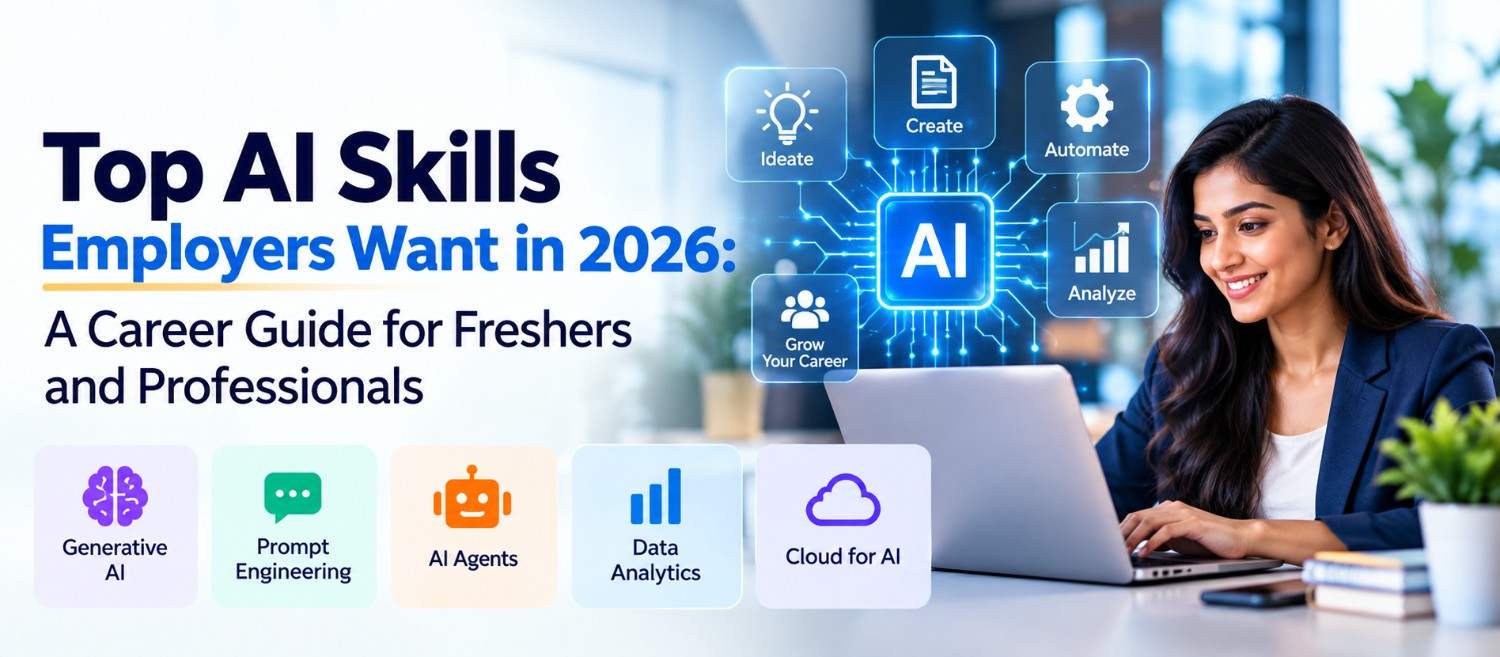
Top AI Skills Employers Want in 2026: A Career Guide for Freshers and Professionals
Artificial Intelligence (AI) is transforming how businesses operate, hire employees and deliver products and services. From automating repetitive tasks to improving business decisions, AI is becoming an important part of workplaces across industries.
In 2026, understanding AI can give job seekers an advantage in a competitive employment market. Employers are increasingly interested in candidates who can use AI tools effectively, analyze information, solve problems and adapt to new technologies.
Whether you are a fresher searching for your first job or an experienced professional planning to upgrade your skills, learning the right AI technologies can help you explore new career opportunities.
In this guide, we will explore the top AI skills employers want in 2026 and how you can start developing them.
Why Are AI Skills Important in 2026?
Businesses across IT, healthcare, banking, retail, manufacturing, education and marketing are exploring AI to improve productivity and customer experiences.
AI is also changing traditional job responsibilities. Professionals in human resources, sales, finance, software development and customer support can use AI tools to automate routine work and focus more on analysis, communication and decision-making.
However, learning AI does not necessarily mean becoming a machine learning engineer. Many employers also value professionals who understand how to apply AI tools to everyday business problems.
Top 10 AI Skills Employers Want in 2026
1. Generative AI
Generative AI tools can create text, images, summaries, presentations and code based on user instructions. Professionals use these tools to accelerate research, content creation, software development and administrative tasks.
What to learn: Explore tools such as ChatGPT, Claude and Gemini. Practise generating content, summarizing documents, analyzing information and reviewing AI-generated outputs.
Career opportunities: AI content specialist, marketing professional, business analyst and AI-enabled operations specialist.
2. Prompt Engineering
Prompt engineering involves writing clear instructions that help AI tools produce relevant and useful results. A good prompt defines the task, provides context, specifies the expected format and includes important constraints.
What to learn: Practise writing structured prompts, refining responses, checking accuracy and creating reusable prompts for common workplace tasks.
Career opportunities: Generative AI specialist, AI consultant, content strategist and automation specialist.
3. AI Agents and Workflow Automation
AI agents can use tools and perform multiple steps toward a goal, depending on their design and permissions. Businesses are exploring agent-based systems for research, customer support, workflow automation and internal operations.
What to learn: Understand agent workflows, tool integrations, human approval steps, testing and error handling. Experiment with automation platforms and low-code AI tools.
Career opportunities: AI automation specialist, AI agent developer and business process automation analyst.
4. Data Analytics and Data Literacy
AI systems depend on data, and professionals must be able to interpret information before making decisions. Data literacy includes understanding trends, identifying inconsistencies and communicating findings clearly.
What to learn: Develop your Excel skills, learn basic statistics and practise using Power BI or Tableau. SQL is useful for working with structured datasets.
Career opportunities: Data analyst, business intelligence analyst, reporting analyst and data-driven business professional.
5. Machine Learning Fundamentals
Machine learning enables computer systems to identify patterns in data and make predictions. Although not every job requires advanced machine learning, understanding its basic concepts helps professionals work effectively with AI technologies.
What to learn: Study supervised and unsupervised learning, model evaluation, training data, overfitting and basic Python programming.
Career opportunities: Junior machine learning engineer, AI analyst and data science associate.
6. Cloud Platforms and AI Deployment
Companies often use cloud platforms to build, access and deploy AI applications. Understanding cloud infrastructure can be valuable for technical professionals working with enterprise AI solutions.
What to learn: Explore introductory AI and cloud services offered by Microsoft Azure, Amazon Web Services (AWS) and Google Cloud. Learn the basics of APIs, authentication, deployment and access controls.
Career opportunities: Cloud engineer, AI solutions engineer and machine learning operations associate.
7. Data Engineering Basics
AI applications require reliable, organized and accessible data. Data engineering focuses on collecting, cleaning, transforming and preparing information for analytics and AI systems.
What to learn: Build familiarity with SQL, Python, data pipelines, ETL processes and data quality checks.
Career opportunities: Junior data engineer, analytics engineer and data operations specialist.
8. AI for Business Applications
Employers value candidates who can connect technology with measurable business outcomes. Knowing how to apply AI to real workplace challenges can be useful even in non-technical roles.
What to learn: Explore AI applications in recruitment, marketing, finance, sales, customer service and reporting. Practise identifying tasks that can be automated safely and measuring the results.
Career opportunities: Business analyst, AI-enabled HR specialist, sales operations analyst and AI implementation consultant.
9. AI Ethics, Privacy and Responsible AI
AI systems can produce inaccurate, biased or misleading outputs. Organizations need professionals who understand privacy, security, fairness and responsible use of AI-generated information.
What to learn: Study data privacy principles, bias, hallucinations, copyright considerations and responsible handling of confidential business information.
Career opportunities: AI governance analyst, risk analyst, compliance specialist and responsible AI consultant.
10. Critical Thinking, Communication and Problem-Solving
Technical knowledge alone is not enough. Professionals must evaluate AI-generated results, recognize errors, communicate recommendations and understand the needs of customers and colleagues.
What to learn: Practise validating AI outputs, explaining complex information in simple language, collaborating with teams and solving real business problems.
Career opportunities: These skills are valuable across technology, management, consulting, sales, marketing and operations.
How Freshers and Professionals Can Build AI Skills
You do not need to master every AI technology at once. Start with a learning plan that matches your career goals.
-
Choose a career direction: Decide whether you want to focus on software development, data analytics, business operations, marketing or another field.
-
Learn the fundamentals: Start with introductory AI courses and practise using generative AI tools.
-
Build practical projects: Create a resume-improvement workflow, a data dashboard, an AI-powered FAQ assistant or a document summarization tool.
-
Create a portfolio: Document the problem, tools used, your approach and the results. Never publish confidential company or customer information.
-
Demonstrate your skills: Add relevant projects and certifications to your resume and professional profiles.
-
Keep learning: AI tools and practices change quickly, so regularly explore new developments and improve your existing skills.
Freshers can focus on foundational knowledge and portfolio projects, while experienced professionals can combine AI with their existing industry expertise.
AI Career Opportunities in 2026
Depending on your skills and experience, AI-related career paths may include:
-
Artificial Intelligence Engineer
-
Generative AI Specialist
-
Machine Learning Engineer
-
Data Analyst
-
AI Automation Specialist
-
AI Agent Developer
-
AI Solutions Consultant
-
Data Engineer
-
AI Governance Analyst
-
Business Analyst with AI Skills
Job titles, required qualifications and salaries vary by employer, location and experience. Review current job descriptions to identify the skills most relevant to your target role.
Conclusion
AI skills are becoming increasingly useful across technical and non-technical careers. Generative AI, prompt engineering, AI agents, data analytics, machine learning fundamentals and responsible AI are valuable areas to explore in 2026.
The best approach is to combine AI knowledge with practical experience, communication and problem-solving skills. You do not need to learn everything at once. Choose a career goal, build relevant projects and demonstrate what you can do.
Ready to take the next step? Explore relevant job openings on FullTimeJobs.com, identify the skills employers request and start preparing for your next career opportunity.
Start learning today and make AI skills part of your career growth plan. |