Introduction
The recruitment landscape is evolving rapidly as artificial intelligence (AI), automation, and changing business requirements reshape how organizations identify and hire talent. For decades, employers relied heavily on academic degrees, certifications, and years of experience to shortlist candidates. While these qualifications remain valuable for many roles, they do not always reflect a candidate’s practical abilities or readiness to perform a job.
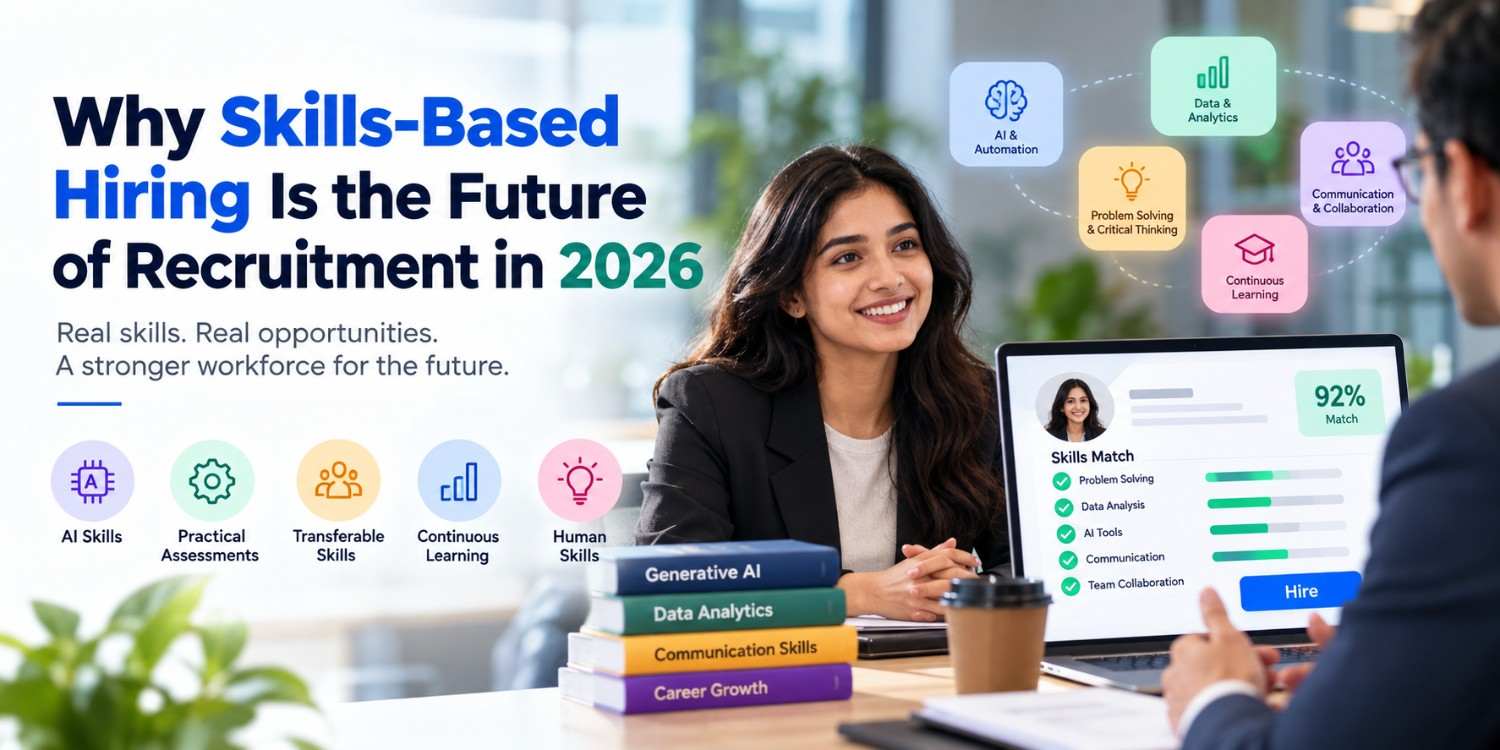
In 2026, employers are increasingly focusing on what candidates can do, how effectively they apply their knowledge, and how quickly they can learn new skills. This approach, known as skills-based hiring, is gaining momentum across technology, finance, marketing, healthcare, consulting, and other industries.
The shift is particularly important as AI changes job responsibilities and creates demand for new technical and human skills. According to the World Economic Forum’s Future of Jobs Report 2025, analytical thinking is the leading core skill identified by employers, while AI, big data, cybersecurity, technological literacy, and adaptability are becoming increasingly important.
Recruitment is no longer just about matching a resume to a job description. It is about identifying candidates who can demonstrate relevant skills, solve real-world problems, collaborate effectively, and adapt to changing workplace demands.
In this article, we explore what skills-based hiring means in 2026, the latest recruitment trends, its benefits for employers and jobseekers, and practical ways organizations can implement a skills-first hiring strategy.
What Is Skills-Based Hiring?
Skills-based hiring is a recruitment approach that evaluates candidates primarily on their relevant competencies, practical abilities, knowledge, and potential rather than relying exclusively on formal qualifications, previous job titles, or years of experience.
Instead of using a degree or a prestigious employer as the primary indicator of suitability, recruiters assess whether candidates possess the skills required to perform a role successfully.
For example, an employer recruiting a digital marketing specialist might evaluate a candidate’s ability to manage campaigns, analyze performance data, use AI-powered marketing tools, and optimize conversion rates. A candidate who demonstrates these capabilities through practical projects may be a strong fit, even without a traditional marketing degree.
Similarly, a software developer might demonstrate proficiency through coding assessments, GitHub projects, technical interviews, or contributions to open-source software.
Skills-based hiring encourages employers to ask:
-
Can the candidate perform the essential tasks associated with this role?
-
Can they demonstrate their skills through projects, assessments, or previous work?
-
Do they have the analytical, communication, and problem-solving abilities needed for success?
-
Can they learn new tools and adapt as job requirements change?
-
Which transferable skills could help them succeed in this position?
The goal is not to eliminate degrees or professional qualifications. Instead, it is to ensure that hiring decisions reflect the actual requirements of a role and the capabilities of each candidate.
Latest Skills-Based Hiring Trends in 2026
1. AI Skills Are Becoming Important Across Industries
Artificial intelligence is changing how employees perform tasks across technology, marketing, finance, customer service, operations, and human resources.
As a result, employers increasingly value candidates who understand how to use AI tools responsibly and effectively. This does not mean every employee needs to become an AI engineer. Many roles require practical AI literacy, including the ability to write effective prompts, review AI-generated outputs, automate routine tasks, and identify potential errors.
Examples of in-demand AI-related capabilities include:
-
Generative AI and prompt engineering
-
AI-assisted research and content creation
-
Data analysis and interpretation
-
Workflow automation
-
Responsible AI use and data privacy awareness
-
Machine learning and AI development for specialized technical roles
Candidates who can demonstrate how they have used AI to improve productivity, solve problems, or support business decisions may stand out during recruitment.
2. Practical Assessments Are Gaining Importance
Traditional interviews and resume screening do not always reveal how well a candidate can perform a job. Employers are therefore using practical assessments to evaluate real-world capabilities.
Depending on the position, these assessments may include coding challenges, writing assignments, case studies, sales simulations, data analysis exercises, or customer-service role-plays.
For example, a business analyst candidate might be asked to interpret a dataset and present recommendations. A sales operations candidate could be asked to analyze a pipeline report and identify forecasting discrepancies.
These exercises help recruiters evaluate a candidate’s reasoning, accuracy, communication, and ability to apply knowledge in realistic situations.
Well-designed assessments should reflect actual job responsibilities, provide reasonable accommodations where needed, and avoid unnecessary assignments that consume excessive candidate time.
3. Human Skills Remain Essential in an AI-Driven Workplace
Although technical skills are becoming increasingly important, human capabilities continue to influence hiring decisions.
The World Economic Forum identifies analytical thinking, resilience, flexibility, agility, leadership, and creative thinking among employers’ important core skills.
As AI takes over more routine tasks, employers still need people who can exercise judgment, understand customers, collaborate across teams, resolve conflicts, and make responsible decisions.
Important human skills include:
-
Critical thinking and problem-solving
-
Communication and active listening
-
Teamwork and collaboration
-
Leadership and decision-making
-
Creativity and innovation
-
Adaptability and emotional intelligence
-
Time management and accountability
Candidates should demonstrate these abilities through specific examples from employment, internships, academic projects, volunteering, or personal initiatives.
4. Transferable Skills Are Opening New Career Paths
Transferable skills are abilities that can be applied across different roles or industries. They are particularly valuable for professionals changing careers, returning to the workforce, or moving into emerging fields.
For example, a customer service professional may have strong communication, conflict-resolution, and customer relationship management skills that are useful in sales operations or account management.
Similarly, a teacher may possess presentation, planning, coaching, and stakeholder-management skills that can support a transition into corporate training or learning and development.
Employers adopting skills-first recruitment can identify these connections rather than rejecting candidates solely because their previous job titles differ from the advertised position.
For jobseekers, this creates opportunities to pursue new careers by demonstrating relevant capabilities and addressing any remaining skill gaps.
5. AI-Powered Recruitment Is Changing Candidate Screening
Recruiters are increasingly using AI-enabled tools to assist with resume screening, candidate matching, interview scheduling, assessments, and recruitment analytics.
These tools can help identify candidates whose skills align with job requirements, including people whose resumes use different terminology from the original job description.
However, AI should support rather than replace sound hiring judgment. Automated screening can reproduce bias, overlook relevant experience, or disadvantage candidates whose backgrounds do not fit historical hiring patterns.
Organizations should use job-related evaluation criteria, review automated decisions, protect candidate information, and monitor hiring outcomes for unfair patterns.
The most effective approach combines technology with structured human evaluation.
6. Continuous Learning Is Becoming a Competitive Advantage
Skills can become outdated as technology, customer expectations, and business processes evolve. Employers increasingly need workers who are willing to learn, develop new capabilities, and apply feedback.
Candidates can demonstrate continuous learning through professional certifications, online courses, workshops, internships, personal projects, and practical experience.
For example, a finance professional who develops data visualization skills or a recruiter who learns AI-assisted sourcing techniques can demonstrate readiness for evolving job requirements.
Employers can also strengthen their skills-first strategy by investing in employee training, reskilling, mentoring, and internal mobility rather than relying entirely on external recruitment.
Why Skills-Based Hiring Is Becoming Essential
1. The Skills Gap Is Changing Workforce Requirements
Organizations often struggle to find candidates who possess the precise capabilities needed for emerging roles. At the same time, qualified candidates may be overlooked because their education or previous job titles do not match traditional expectations.
Skills-based hiring helps employers broaden their talent pools and focus on the competencies that matter most.
2. Technology Is Evolving Faster Than Job Requirements
AI, cloud computing, cybersecurity, automation, and data analytics are changing responsibilities across industries.
A candidate’s ability to learn and apply new tools can therefore be as important as their existing knowledge. Skills-first recruitment helps employers identify people who can adapt to changing requirements.
3. Traditional Hiring Criteria Can Exclude Capable Candidates
Overreliance on degree requirements, college reputation, or a fixed number of years of experience can exclude capable applicants.
A skills-first approach allows employers to consider candidates who have acquired relevant knowledge through alternative education, vocational training, self-directed learning, internships, apprenticeships, or professional experience.
This can widen access to employment while helping organizations identify overlooked talent.
4. Career Paths Are Becoming More Flexible
Professionals increasingly move between industries, job functions, and employment arrangements throughout their careers.
Transferable skills make these transitions possible. By evaluating candidates on their demonstrated abilities rather than their previous job titles alone, employers can identify individuals who are capable of succeeding in new roles.
Benefits of Skills-Based Hiring
Benefits for Employers
1. Better candidate-job matching
Evaluating job-related skills helps recruiters assess whether candidates can perform essential responsibilities and meet business requirements.
2. Access to a broader talent pool
Employers can consider qualified applicants from different educational institutions, career paths, and professional backgrounds.
3. More structured hiring decisions
Standardized assessments and clear competency criteria can make comparisons between candidates more consistent.
4. Potential improvements in retention
When hiring decisions align with actual job requirements and realistic expectations, employees may be better positioned to succeed and grow in their roles.
5. Support for workforce planning
Skills-based recruitment helps organizations identify capability gaps, determine training needs, and prepare for changing business priorities.
6. Greater opportunities for internal mobility
Mapping employees’ existing skills to new positions can help organizations fill vacancies internally and retain institutional knowledge.
Benefits for Jobseekers
1. More opportunities beyond traditional qualifications
Candidates can demonstrate their abilities through projects, portfolios, assessments, certifications, and relevant experience.
2. Easier career transitions
Transferable skills can help professionals move into new roles without starting their careers from scratch.
3. Clearer professional development goals
Understanding the skills required for a target role helps candidates identify learning priorities and choose relevant training.
4. Recognition of practical experience
Internships, freelance projects, apprenticeships, volunteer work, and personal projects can provide evidence of job-related capabilities.
5. Greater emphasis on continuous improvement
Candidates can strengthen their employability by regularly updating their skills and documenting their achievements.
Real-World Examples of Skills-Based Hiring
Skills-first recruitment is increasingly discussed and implemented across industries, although the extent of adoption varies by organization, role, and country.
-
Technology companies: Employers may use coding assessments, technical projects, and practical problem-solving exercises to evaluate software development candidates.
-
Digital marketing teams: Candidates may be assessed on campaign planning, analytics, SEO, content strategy, and their ability to use AI-assisted tools.
-
Sales and business operations: Employers may evaluate CRM knowledge, pipeline reporting, forecasting, spreadsheet analysis, and communication skills through practical exercises.
-
Customer service organizations: Role-play scenarios can help assess communication, product knowledge, conflict resolution, and customer empathy.
-
Entry-level recruitment: Internships, apprenticeships, work samples, and project portfolios can provide evidence of capability beyond academic grades.
Research also supports the growing importance of skills-first approaches. LinkedIn’s Future of Recruiting 2025 report found that companies making greater use of skills-based searches were 12% more likely to make a quality hire, based on LinkedIn’s platform data.
These examples illustrate how employers can evaluate candidates based on job-relevant evidence rather than relying exclusively on traditional credentials.
How Companies Can Implement Skills-Based Hiring
1. Redesign Job Descriptions Around Skills
Start by identifying the capabilities genuinely required for success in each position.
Separate essential skills from skills that can be learned after hiring. Avoid including degree requirements or years of experience simply because they appeared in previous job descriptions.
For example, a business analyst vacancy could prioritize data interpretation, requirements gathering, stakeholder communication, and relevant analytical tools.
2. Create Structured Skills Assessments
Develop assessments that reflect real responsibilities associated with the role.
Examples include:
-
Coding tasks for software development positions
-
Writing samples for content and communications roles
-
Case studies for consulting and business analysis
-
Data exercises for finance and operations
-
Role-play scenarios for sales and customer support
Use consistent scoring criteria so candidates are evaluated against the same job-related standards.
3. Use AI Responsibly in Recruitment
AI tools can support resume matching, skills inference, candidate communication, and assessment administration.
Organizations should establish clear policies for data privacy, human oversight, transparency, accessibility, and bias monitoring. Candidates should not be rejected solely because an automated system fails to recognize a relevant skill.
4. Evaluate Work Samples and Portfolios
Work samples provide tangible evidence of what candidates can accomplish.
Depending on the role, employers can review GitHub repositories, writing portfolios, design projects, marketing campaign examples, dashboards, research projects, or anonymized professional work.
Assess the quality and relevance of the work rather than the prestige of the platform or organization associated with it.
5. Train Recruiters and Hiring Managers
Recruiters need clear competency frameworks and structured interview techniques to evaluate candidates consistently.
Training should cover transferable skills, evidence-based interviewing, inclusive assessment practices, and the appropriate use of AI recruitment tools.
Hiring managers should also learn to distinguish between skills that are essential on day one and those that can be developed through training.
6. Invest in Upskilling and Reskilling
Not every candidate needs to possess every desirable skill before joining an organization.
Employers can build training plans that address manageable skill gaps, improve employee performance, and prepare workers for changing responsibilities.
Internal training and mentoring can also help organizations fill positions without always recruiting externally.
7. Measure Recruitment Outcomes
Track whether the skills-first strategy is producing meaningful results.
Useful metrics include time to hire, assessment performance, quality of hire, retention, candidate experience, internal mobility, and hiring outcomes across different candidate groups.
Review these indicators regularly and adjust the process when assessments are not accurately predicting performance.
Challenges of Skills-Based Hiring
Despite its advantages, skills-based hiring requires careful planning and implementation.
Resistance to change: Some hiring managers may continue to rely heavily on degrees, job titles, or years of experience.
Assessment quality: Poorly designed tests may measure speed, test-taking ability, or familiarity with a specific platform instead of genuine job competence.
Implementation costs: Developing assessment frameworks, training recruiters, and maintaining technology can require time and resources.
AI-related bias: Automated recruitment systems may overlook qualified applicants or reproduce historical biases if they are not properly evaluated.
Difficulty measuring soft skills: Communication, leadership, and adaptability can be harder to assess objectively than certain technical skills.
Risk of overemphasizing current skills: Employers may miss candidates with strong learning potential if they focus only on skills that can be demonstrated immediately.
Organizations can address these challenges through job-related assessments, structured interviews, human oversight, accessible recruitment processes, and ongoing evaluation of hiring outcomes.
How Jobseekers Can Prepare for Skills-Based Hiring in 2026
Candidates can take several practical steps to improve their chances of success in a skills-first job market.
Identify the Skills Required for Your Target Role
Review current job descriptions to identify recurring technical skills, software tools, industry knowledge, and interpersonal competencies.
Focus on requirements that appear frequently across relevant vacancies.
Build a Portfolio of Practical Work
Create examples that demonstrate your capabilities. These could include personal projects, sample reports, dashboards, writing samples, coding projects, marketing campaigns, or case studies.
If your work contains confidential employer or customer information, use anonymized or independently created examples instead.
Develop AI and Digital Literacy
Learn how AI tools and digital technologies apply to your profession. Practice using them to improve productivity while checking the accuracy, quality, and appropriateness of their outputs.
Technical AI development skills may be essential for specialized roles, whereas general AI literacy may be sufficient for many other positions.
Highlight Achievements on Your Resume
Describe what you accomplished, which skills you used, and what results you achieved.
For example, instead of writing “Responsible for sales reports,” write “Prepared weekly sales pipeline reports, identified data discrepancies, and improved reporting accuracy.”
Use measurable results when you have reliable evidence to support them.
Prepare for Practical Interviews
Practice solving problems relevant to your target position. Be prepared to explain your approach, the decisions you made, the tools you used, and what you learned.
For behavioural questions, use specific examples that demonstrate communication, teamwork, problem-solving, and adaptability.
Continue Learning and Updating Your Skills
Choose learning opportunities that align with real job requirements. Online courses, professional certifications, internships, and hands-on projects can all contribute to your development.
The goal is not to collect certificates indiscriminately, but to build relevant skills and demonstrate that you can apply them.
The Future of Recruitment: A Skills-First Approach
In 2026 and beyond, recruitment is likely to become increasingly focused on demonstrated capabilities, adaptability, and continuous learning. AI will continue to influence how candidates are sourced and evaluated, while practical assessments and structured interviews can help employers understand what applicants are genuinely capable of doing.
However, skills-based hiring does not mean that degrees, professional licenses, or previous experience are no longer important. Certain professions require specific qualifications, regulatory credentials, or substantial experience. The appropriate approach depends on the responsibilities and risks associated with each role.
For employers, the opportunity lies in building recruitment processes that recognize talent more accurately, evaluate candidates consistently, and identify potential for future growth.
For jobseekers, the opportunity is to demonstrate their capabilities through relevant experience, practical projects, and a commitment to learning.
The future of recruitment will increasingly depend on finding the right combination of technical expertise, human skills, and the ability to adapt.
Conclusion
Skills-based hiring is becoming an important part of modern recruitment as employers respond to technological change, evolving job requirements, and competition for capable talent.
By prioritizing relevant skills, practical assessments, transferable capabilities, and continuous learning, organizations can broaden their talent pools and make more informed hiring decisions. Jobseekers can also benefit by demonstrating what they can do rather than relying solely on degrees or previous job titles.
As AI and automation continue to reshape the workplace, the strongest candidates will be those who combine relevant professional knowledge with critical thinking, communication, adaptability, and a willingness to learn.
The future of recruitment is not simply about where you studied or where you worked. It is about the skills you can demonstrate, the problems you can solve, and the value you can bring to an organization.
Frequently Asked Questions (FAQs)
What is skills-based hiring?
Skills-based hiring is a recruitment approach that evaluates candidates primarily on job-related abilities and competencies rather than relying exclusively on degrees, job titles, or years of experience.
Why is skills-based hiring becoming popular in 2026?
Employers are responding to skills gaps, rapid technological change, AI adoption, and the need to identify candidates who can perform real job responsibilities and adapt to new requirements.
Can I get a job without a degree through skills-based hiring?
Yes, for some positions. Employers may accept practical experience, portfolios, certifications, assessments, or alternative training in place of a degree when formal qualifications are not essential to the role.
Which skills are most valuable to employers in 2026?
Important skills include analytical thinking, AI and data literacy, technological proficiency, problem-solving, communication, adaptability, cybersecurity awareness, and continuous learning. The exact requirements vary by industry and job.
How can freshers prepare for skills-based recruitment?
Freshers can develop practical projects, pursue internships, learn relevant tools, complete targeted courses, build portfolios, and prepare for job-related assessments and structured interviews.
Will AI replace traditional recruitment?
AI is likely to automate or assist with some recruitment activities, including screening and scheduling. However, human judgment remains important for evaluating context, communication, fairness, potential, and suitability for a role.
How can employers measure the success of skills-based hiring?
Employers can monitor quality of hire, time to hire, employee retention, assessment performance, candidate experience, internal mobility, and the fairness of hiring outcomes.
|