Artificial intelligence (AI) is transforming the way people work. From customer service chatbots to advanced data analysis, AI is helping businesses complete tasks faster, reduce costs, and improve efficiency. While this technological shift has raised concerns about job losses, it has also created new opportunities. The reality is that AI is unlikely to replace every profession. Instead, it will change how people work, making many jobs more productive and creating demand for new skills.
The future workplace will not be about humans competing with AI. It will be about humans working alongside AI. Professionals who can combine creativity, emotional intelligence, critical thinking, and technical knowledge with AI tools will continue to be in high demand. Understanding which careers are less vulnerable to automation can help students, job seekers, and working professionals prepare for the future.
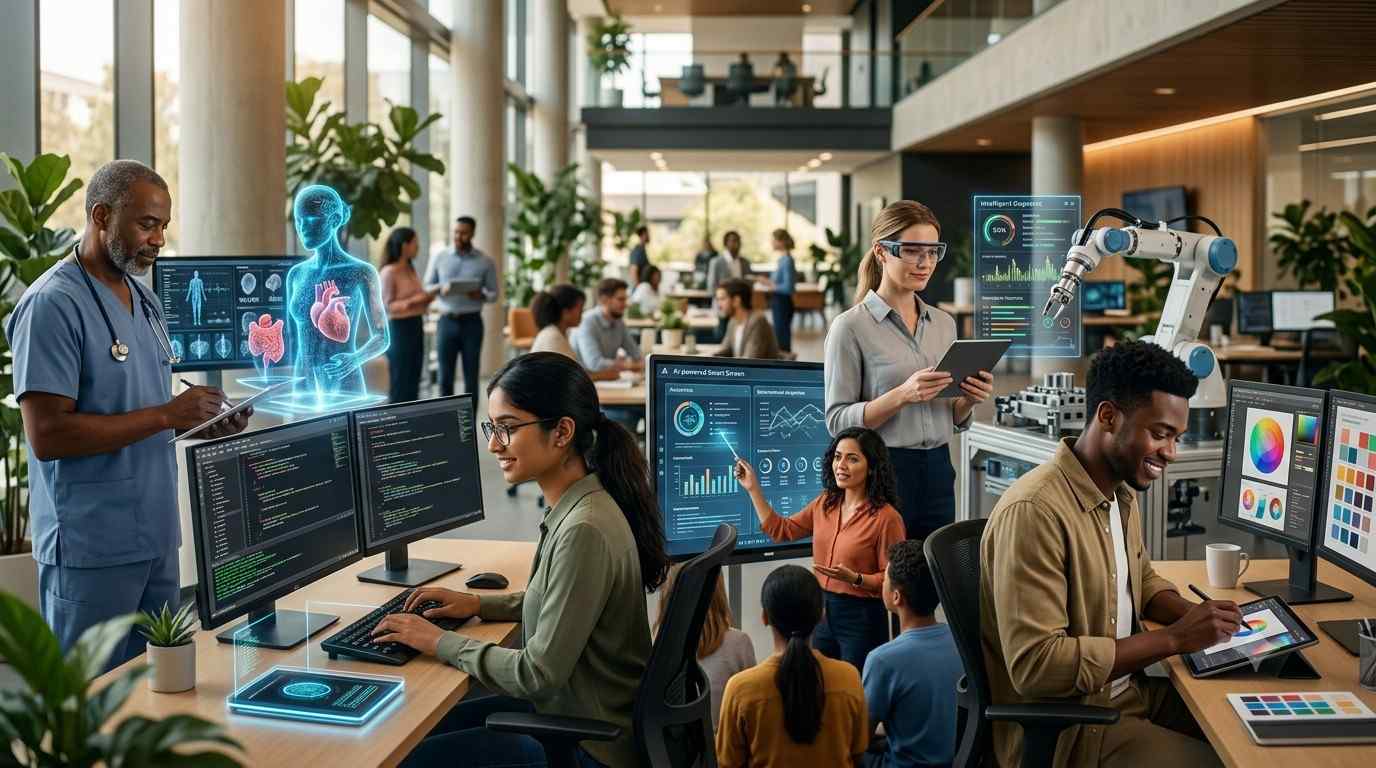
Why AI Cannot Replace Every Job
AI is excellent at performing repetitive, rule-based, and data-driven tasks. It can analyze massive amounts of information, identify patterns, generate reports, and even create content within seconds. However, AI has important limitations. It cannot genuinely understand human emotions, build meaningful relationships, make ethical judgments, or think creatively in the same way humans do.
Many professions require empathy, leadership, adaptability, and complex decision-making. These qualities are difficult to automate because they depend on human experiences, values, and communication. As technology continues to evolve, the demand for these uniquely human skills will increase rather than disappear.
Healthcare Professionals
Healthcare remains one of the safest industries despite rapid technological advancement. Doctors, nurses, surgeons, therapists, physiotherapists, and mental health counselors rely on personal interaction, empathy, and clinical judgment. While AI can assist by analyzing medical images, predicting diseases, or recommending treatments, final decisions still require experienced healthcare professionals.
Patients also need emotional support and reassurance during difficult times. A machine cannot replace the compassion shown by a nurse caring for a patient or a doctor explaining complex treatment options. AI will become a valuable assistant in healthcare, but human professionals will remain at the center of patient care.
Teachers and Educators
Education is about much more than delivering information. Teachers inspire, motivate, mentor, and guide students throughout their learning journey. AI-powered learning platforms can personalize lessons and automate grading, but they cannot replace the human connection between teachers and students.
Educators understand individual learning styles, encourage critical thinking, resolve classroom conflicts, and help students develop confidence. As education increasingly adopts technology, teachers who effectively integrate AI into their classrooms will become even more valuable.
Skilled Trades
Electricians, plumbers, carpenters, mechanics, construction workers, and HVAC technicians perform hands-on work in constantly changing environments. These jobs require problem-solving, physical skills, and adaptability that robots currently struggle to replicate.
Each repair or installation presents unique challenges that require human judgment and experience. Although technology can assist with diagnostics and planning, skilled trade professionals will continue to be essential for maintaining homes, businesses, and infrastructure.
Software Developers and AI Specialists
Many people assume AI will replace programmers, but the opposite is happening. AI tools can generate code, identify bugs, and automate repetitive programming tasks. However, software developers are still needed to design applications, understand business requirements, solve complex problems, and ensure software quality.
The demand for AI engineers, machine learning specialists, cybersecurity experts, cloud architects, and data scientists continues to grow as organizations invest in digital transformation. Professionals who understand how to build, manage, and improve AI systems will enjoy strong career opportunities in the coming years.
Creative Professionals
Creativity remains one of humanity's greatest strengths. Graphic designers, writers, filmmakers, musicians, photographers, video editors, architects, and marketing professionals bring originality, storytelling, and cultural understanding to their work.
AI can generate images, write articles, and create videos, but it often relies on existing patterns rather than producing truly original ideas. Human creativity, combined with AI-powered design and content tools, allows professionals to work faster while maintaining authenticity and innovation.
Businesses increasingly value creative professionals who can use AI as a productivity tool rather than viewing it as competition.
Business Leaders and Managers
Leadership requires strategic thinking, communication, negotiation, conflict resolution, and decision-making. Managers motivate teams, build organizational culture, mentor employees, and make complex business decisions that involve uncertainty and human behavior.
AI can provide valuable insights through data analysis and forecasting, but it cannot replace effective leadership. Organizations will continue to need leaders who can balance technology with people management and long-term business strategy.
Legal and Financial Professionals
Lawyers, judges, financial advisors, accountants, auditors, and compliance officers work with regulations, ethics, and complex client situations. AI can review documents, detect fraud, and perform financial analysis, making these professionals more efficient.
However, interpreting laws, negotiating settlements, advising clients, and making ethical decisions require human expertise. Professionals who combine industry knowledge with AI-powered research tools will deliver faster and more accurate services.
Human Resource Professionals
Recruitment and human resource management involve understanding people, resolving workplace conflicts, conducting interviews, and building positive organizational cultures. While AI can screen resumes, schedule interviews, and analyze workforce data, hiring decisions still depend on human judgment.
HR professionals also play a crucial role in employee engagement, career development, diversity initiatives, and organizational change. These responsibilities require emotional intelligence and interpersonal skills that AI cannot fully replicate.
Customer Experience Specialists
Although AI chatbots handle many routine customer inquiries, complex customer service situations often require human support. Customer success managers, relationship managers, sales consultants, and hospitality professionals build trust and long-term relationships.
Customers appreciate empathy, patience, and personalized assistance when facing important decisions or challenging situations. Businesses that prioritize exceptional customer experiences will continue investing in skilled professionals who understand people.
Emerging Careers Created by AI
Rather than eliminating all jobs, AI is creating entirely new career paths. Many organizations are actively hiring professionals with expertise in artificial intelligence and related technologies.
Some of the fastest-growing careers include:
- AI Prompt Engineer
- Machine Learning Engineer
- AI Ethics Consultant
- AI Product Manager
- Data Scientist
- Robotics Engineer
- Cybersecurity Specialist
- Cloud Engineer
- AI Trainer
- Automation Consultant
These roles demonstrate that technological advancement often creates more opportunities than it removes, especially for people willing to learn new skills.
Skills That Will Keep You Employable
Regardless of your profession, developing future-ready skills is essential. Employers increasingly value individuals who can adapt to technological change and work effectively with AI tools.
Some of the most important skills include:
- Critical thinking and problem-solving
- Communication and collaboration
- Creativity and innovation
- Emotional intelligence
- Leadership and teamwork
- Digital literacy
- AI and data literacy
- Adaptability and continuous learning
- Time management
- Ethical decision-making
Professionals who combine technical knowledge with strong interpersonal skills will remain highly competitive in the evolving job market.
How to Prepare for the Future
Preparing for an AI-driven workplace does not necessarily mean becoming a programmer or AI engineer. Every professional can benefit from understanding how AI works and learning to use AI-powered tools effectively.
Start by taking online courses, earning certifications, and experimenting with AI applications relevant to your field. Stay updated with industry trends, attend workshops, and continuously improve both technical and soft skills. Building a mindset of lifelong learning is one of the best investments you can make for your career.
Instead of fearing automation, focus on becoming someone who knows how to use AI to solve problems more efficiently. Employers are increasingly looking for individuals who can combine human expertise with technological capabilities.
Conclusion
The AI revolution is changing the world of work, but it is not the end of human employment. While repetitive and routine tasks are becoming automated, careers that depend on creativity, empathy, leadership, strategic thinking, and complex decision-making will continue to thrive.
The future belongs to professionals who embrace change rather than resist it. By learning new technologies, strengthening human-centered skills, and adapting to evolving workplace demands, individuals can build rewarding careers that remain valuable in the age of artificial intelligence.
AI is not here to replace humans entirely. It is here to transform how we work. Those who learn to collaborate with AI instead of competing against it will be best positioned for long-term career success. |