Introduction
Choosing between entrepreneurship and employment has always been a significant career decision. But in today’s rapidly evolving job market—driven by technology, AI, remote work, and economic shifts—the choice has become even more complex.
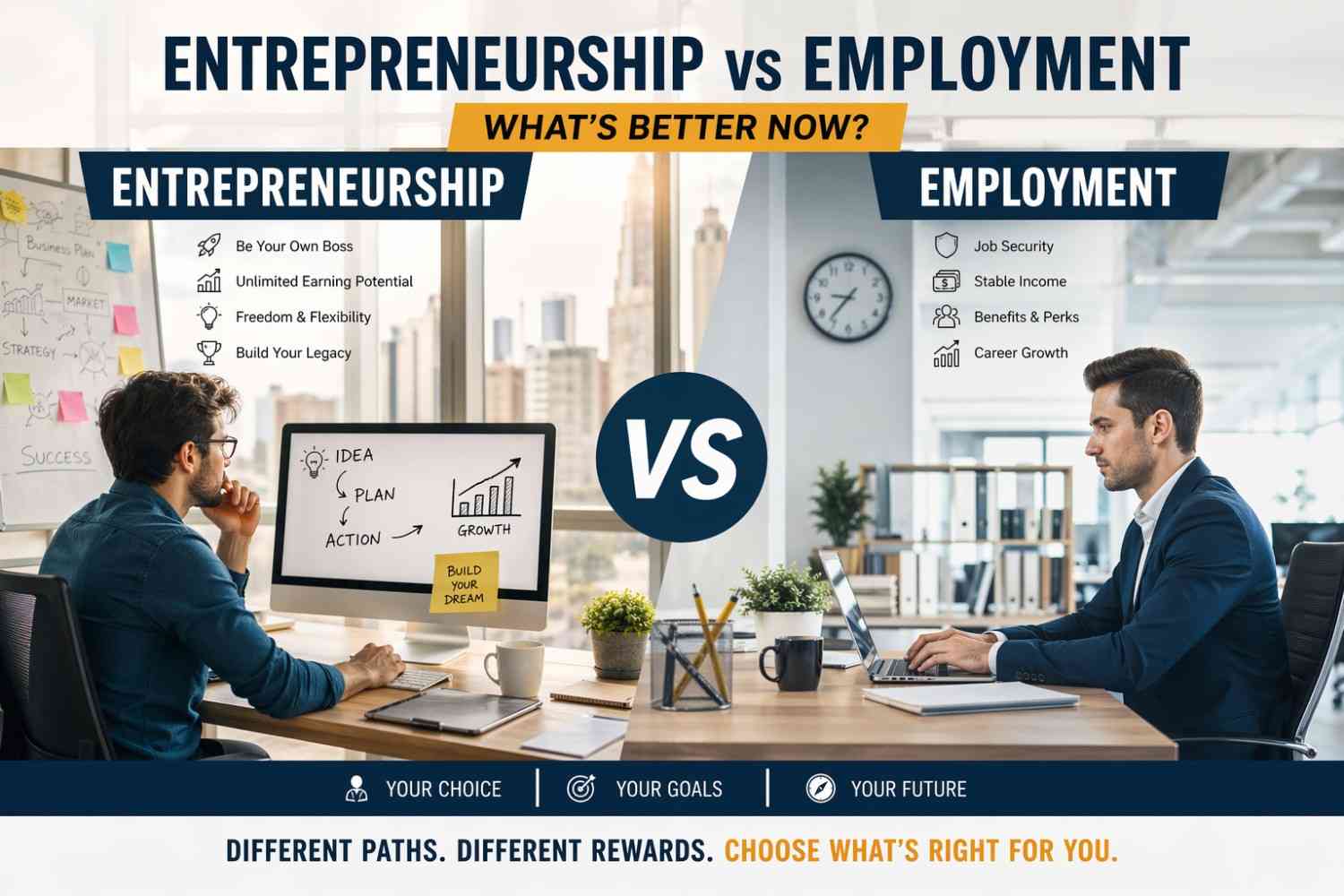
On one hand, entrepreneurship promises independence, innovation, and unlimited earning potential. On the other, employment offers stability, structured growth, and financial security.
So, what’s better now? The answer isn’t universal—it depends on your goals, risk tolerance, and lifestyle preferences. Let’s break it down in detail.
What is Employment?
Employment refers to working for an organization where you are paid a fixed salary in exchange for your time, skills, and contributions.
Key Features:
-
Fixed monthly income
-
Defined job roles and responsibilities
-
Employee benefits (insurance, paid leave, bonuses)
-
Structured career growth
Employment is the traditional and still the most common career path worldwide.
What is Entrepreneurship?
Entrepreneurship involves starting and managing your own business, taking financial risks in the hope of earning profits and achieving independence.
Key Features:
-
Self-employment or business ownership
-
No fixed income (initially)
-
High risk, high reward
-
Freedom to innovate and lead
Entrepreneurs create opportunities—not just for themselves, but often for others as well.
Key Differences Between Entrepreneurship and Employment
1. Risk vs Stability
The biggest difference lies in risk.
-
Employment: Offers financial stability with a steady paycheck
-
Entrepreneurship: Involves uncertainty, especially in the early stages
If you prefer security, employment is the safer choice. If you’re comfortable with uncertainty, entrepreneurship may suit you better.
2. Income Potential
-
Employment: Fixed salary with incremental raises
-
Entrepreneurship: Unlimited earning potential (but not guaranteed)
While employees earn predictable income, entrepreneurs can scale their earnings significantly if their business succeeds.
3. Work-Life Balance
-
Employment: Fixed working hours (in most cases)
-
Entrepreneurship: Long, irregular hours, especially initially
Entrepreneurs often work more than employees, particularly during the startup phase.
4. Freedom and Control
-
Employment: Limited control over decisions
-
Entrepreneurship: Full control over business and direction
Entrepreneurs enjoy independence but also carry full responsibility.
5. Skill Development
-
Employment: Specialized skill development within a role
-
Entrepreneurship: Multi-skill development (finance, marketing, operations, leadership)
Entrepreneurship accelerates learning but requires adaptability.
Advantages of Employment
1. Financial Security
A stable salary ensures consistent income and easier financial planning.
2. Benefits and Perks
Health insurance, retirement plans, and paid leaves add long-term value.
3. Structured Growth
Clear career paths and promotions help in long-term development.
4. Lower Risk
Employees are not directly affected by business losses.
Disadvantages of Employment
-
Limited earning potential compared to business owners
-
Less flexibility and independence
-
Dependence on employer decisions
-
Risk of layoffs in uncertain markets
Advantages of Entrepreneurship
1. Unlimited Growth Potential
There is no cap on how much you can earn or grow.
2. Independence
You make your own decisions and build your vision.
3. Opportunity Creation
Entrepreneurs create jobs and contribute to the economy.
4. Personal Satisfaction
Building something from scratch can be highly fulfilling.
Disadvantages of Entrepreneurship
-
Financial uncertainty
-
High stress and responsibility
-
Risk of failure
-
Requires strong discipline and resilience
What’s Better in Today’s Market?
In 2026, the line between entrepreneurship and employment is becoming increasingly blurred.
Why Employment Still Matters:
-
Companies are offering competitive salaries and benefits
-
Hybrid and remote work options improve flexibility
-
Skill-based hiring is opening new opportunities
Why Entrepreneurship is Growing:
-
Digital platforms make starting a business easier
-
Freelancing and side hustles are rising
-
AI tools reduce operational costs
-
People seek independence and multiple income streams
The Rise of Hybrid Careers
One of the most important trends today is the rise of hybrid careers.
Many professionals are:
-
Working full-time jobs while running side businesses
-
Freelancing alongside employment
-
Building startups while maintaining income security
This approach reduces risk while exploring entrepreneurial opportunities.
How to Decide What’s Right for You
Ask yourself these questions:
Choose Employment If:
-
You prefer stability and predictable income
-
You want structured career growth
-
You are risk-averse
-
You value work-life balance
Choose Entrepreneurship If:
-
You are comfortable taking risks
-
You want independence and control
-
You have a strong business idea
-
You are ready to handle uncertainty
Future Outlook
The future of work is not about choosing one over the other—it’s about adaptability.
-
More professionals will combine both paths
-
Gig economy and startups will continue to grow
-
Companies may hire more contract-based talent
-
Skills will matter more than job titles
Conclusion
Entrepreneurship and employment each offer unique advantages and challenges. There is no one “better” option—it depends on your personal goals, financial situation, and risk appetite.
If you value security and structure, employment is a solid choice. If you seek freedom and high growth potential, entrepreneurship may be the right path.
In today’s dynamic world, the smartest approach is to stay flexible, continuously upgrade your skills, and remain open to both opportunities. |